

Safety & Repair Guide
Garage Door Off Track: Why It Happens and How to Fix It
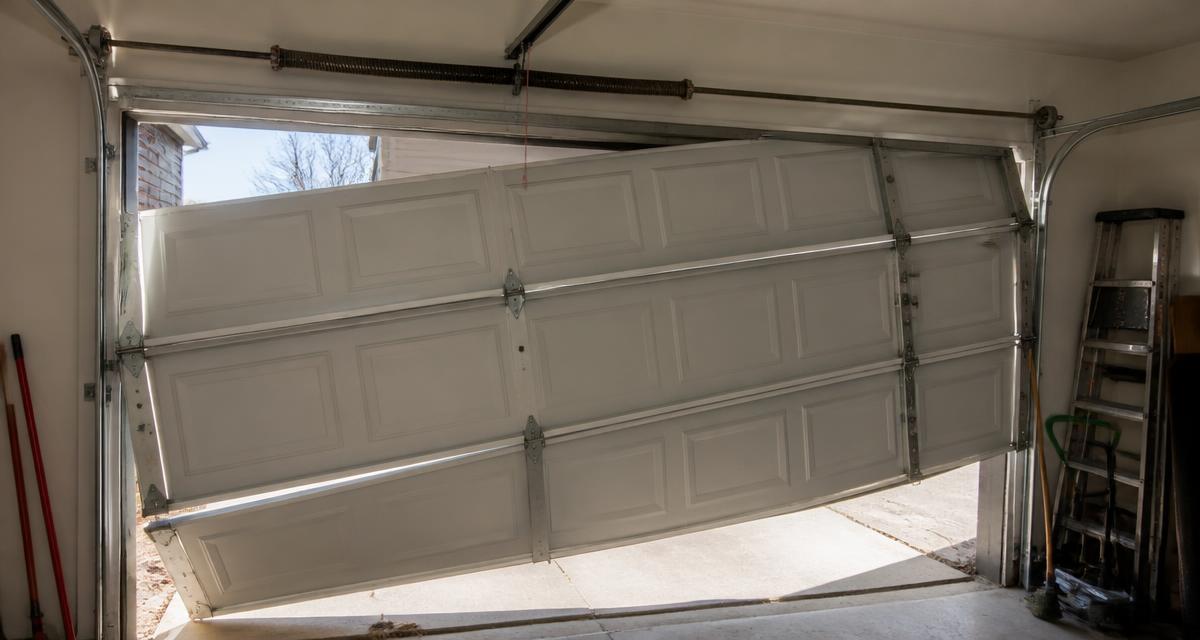
Of every problem a homeowner is tempted to fix in the garage on a Saturday, an off-track door is the one we'd most like you to leave alone. It looks mechanical and obvious — the roller is out of the rail, put it back — but the door is still connected to torsion springs holding hundreds of pounds of stored energy, and it's now unsupported on at least one side. That combination is how people get hurt.
TL;DR
Off-track doors are caused by broken rollers, bent track from vehicle impact, loose brackets, or a snapped cable. Stop using the door immediately — running the opener turns a $200 repair into panel and cable damage. Tightening a loose bracket is DIY-safe; anything involving lifting the door, cables, or spring tension is not. Charlotte-area repairs typically run $150–$600.
Signs your door is off track
- A visible gap between a roller and the track, or a roller sitting outside the rail entirely.
- The door hangs crooked — one side noticeably higher than the other.
- Grinding, scraping, or a hard metallic bang during operation.
- The door jerks, hesitates, or moves unevenly rather than gliding.
- Daylight gaps along one side or the bottom when the door is closed.
- The opener strains, stops early, or reverses without an obstruction.
- A visibly bowed, kinked, or separated section of track.
If you're seeing these right now: leave the door where it is, unplug the opener so nobody cycles it, and park outside. Cycling an off-track door is what turns a roller replacement into bent track, torn hinges, and creased panels.
What causes a garage door to come off track
Broken roller
The most common cause. Steel rollers with unsealed bearings last about 5–7 years; when the bearing seizes, the roller drags instead of rolling and eventually shears its stem or pops the rail. Nylon rollers with sealed 13-ball bearings last two to three times as long and are quieter — see roller replacement.
Bent track from vehicle impact
Backing into a partially open door, clipping the vertical track with a bumper, or bumping a track with a ladder or mower deflects the rail out of its radius. Even a small crimp is enough — the roller catches on the deformity, climbs, and jumps out. Impacted track sections should be replaced, not hammered back.
Loose track brackets and hardware
Roughly 1,500 cycles a year of vibration slowly backs out lag bolts holding the track brackets to the jamb. As the rail loosens, spacing drifts, and the door starts riding the edge of the track. This is the one cause you can genuinely prevent with a socket wrench twice a year.
Cable failure pulling the door sideways
Lift cables carry the spring's force down to the bottom brackets. When one snaps or unspools from its drum, that side of the door drops while the other keeps lifting — the door racks in the opening and comes off track immediately. Full detail in garage door cable snapped.
Is it safe to fix yourself?
Honest answer, same as we give on DIY vs. professional spring repair: some of it, yes. Most of it, no.
Reasonable to do yourself
- Tightening loose track brackets and lag bolts with the door closed
- Clearing debris or an object jammed in the track
- Wiping the track clean (never grease the inside of a track)
- Unplugging the opener to prevent further damage
Leave to a technician
- Lifting or repositioning the door back into the track
- Anything touching cables, drums, or the torsion shaft
- Replacing or straightening track sections
- A door that's crooked, racked, or partially open and stuck
- Any off-track door with a broken spring or cable
The specific hazard: to re-seat a roller you have to relieve load from the door, and an off-track door does not distribute that load predictably. It can shift suddenly. Technicians use locking pliers on the track, winding bars, and a second set of hands for exactly that reason.
Bent track: repair or replace the section?
- Light bowing in the flange can often be trued in place with the right tooling.
- A crimp, kink, or tear means replace the section. Steel that's been folded won't hold a true radius again.
- Damage at the curve (where vertical meets horizontal) is almost always a replacement — that radius is where the door is most sensitive to geometry.
- Rust-through at the floor end, common on older Carolina garages with standing water, needs replacement regardless of shape.
Track sections are inexpensive relative to the labor of coming back a second time, so if a section is questionable, replacing it during the same visit is usually the cheaper decision.
Cost to fix an off-track garage door in Charlotte
| Job | Typical installed cost |
|---|---|
| Roller replacement + re-track (single side) | $150 – $300 |
| Bent vertical track section replacement | $200 – $400 |
| Full track realignment (both sides) | $250 – $450 |
| Cable replacement + re-track combo | $325 – $600 |
| Full nylon roller set (10–12 rollers) | $180 – $350 |
| Damaged panel replacement | Quoted per panel |
Charlotte-metro residential ranges, quoted flat-rate in writing before work starts. More in the repair cost guide.
What happens if you keep using an off-track door
- The damage compounds. Each cycle bends more track, tears hinges out of panels, and creases sections. A $200 roller job becomes a $900 panel-and-track job.
- Cables unspool. A racked door lets cable jump the drum, which can drop one side of the door without warning.
- The opener burns out. Forcing a binding door drives the motor past its force limits and strips the drive gear.
- Real injury risk. A double door weighs 150–350 lbs. Unsupported on one side, it can fall on a vehicle, a pet, or a person.
- Insurance and liability. Continuing to operate a door you knew was damaged can weaken a claim, especially on a rental or commercial property.
Frequently asked questions
What causes a garage door to come off track?
Four causes account for nearly every off-track door: a broken or seized roller that jumps the rail, a track bent by vehicle impact, loose track brackets or lag bolts that let the rail shift, and a snapped lift cable that pulls one side of the door out of alignment. Doors that bind because of worn hinges or a shifted torsion tube come off track over time as well.
Is it safe to use a garage door that's off track?
No. An off-track door is unsupported on at least one side, and running the opener puts the load onto cables, brackets, and panels that were never meant to carry it. Doors have fallen from this. Stop operating it, keep people and vehicles out from under it, and get it inspected.
Can I fix an off-track garage door myself?
Minor cases only. Tightening a loose track bracket or lag bolt with the door closed is reasonable. Anything that involves lifting the door back into the track, releasing cable tension, or working near the torsion spring is not — the springs hold hundreds of pounds of stored energy, and a door that shifts while you're repositioning it can crush a hand or drop entirely.
How much does it cost to fix an off-track garage door?
In the Charlotte area, a straightforward re-track with a roller swap typically runs $150–$300. Replacing a bent vertical track section runs $200–$400. A full track realignment on both sides runs $250–$450. A combined cable plus track job runs $325–$600. Panel damage from the door binding is quoted separately.
Can a bent garage door track be repaired or does it need replacing?
Light bowing in the flat flange can sometimes be straightened in place. A crimped, kinked, or torn track — the usual result of vehicle impact — should be replaced. A hammered-back track never returns to a true radius, and the door will keep binding and jumping until the section is swapped out.
How long does off-track repair take?
Most re-tracks and roller replacements finish in 60–90 minutes. A bent section replacement typically takes 1–2 hours. If cables, drums, or panels are involved as well, plan on two to three hours.
Will homeowners insurance cover an off-track garage door?
When the cause is a sudden accident such as backing a vehicle into the door, many policies cover the repair minus the deductible. Wear and tear — worn rollers, loose hardware, frayed cables — is normally excluded as maintenance. We provide itemized written documentation you can submit either way.
Related reading
- DIY vs. professional spring repair
- Garage door cable snapped: what to do
- Roller replacement service
- Cable repair service
- Maintenance & safety inspection
Door off track right now? Don't run it.
Off-track doors are an emergency call for us — we secure the door, re-track it safely, and replace whatever failed. 24/7 dispatch across Charlotte and the Carolinas, flat-rate written pricing before any work starts.
Ready to fix it?
Off-track doors bend panels fast. We realign tracks and rollers on the first visit.
- Garage door repairSame-day diagnosis with flat-rate written pricing.
- Cable repairSnapped cables, drums and off-track doors made safe fast.