

Steel vs. Wood Garage Doors: Which Is Right for Your Home?
A side-by-side look at how steel and wood garage doors compare on cost, maintenance, insulation, and curb appeal — with honest tradeoffs.
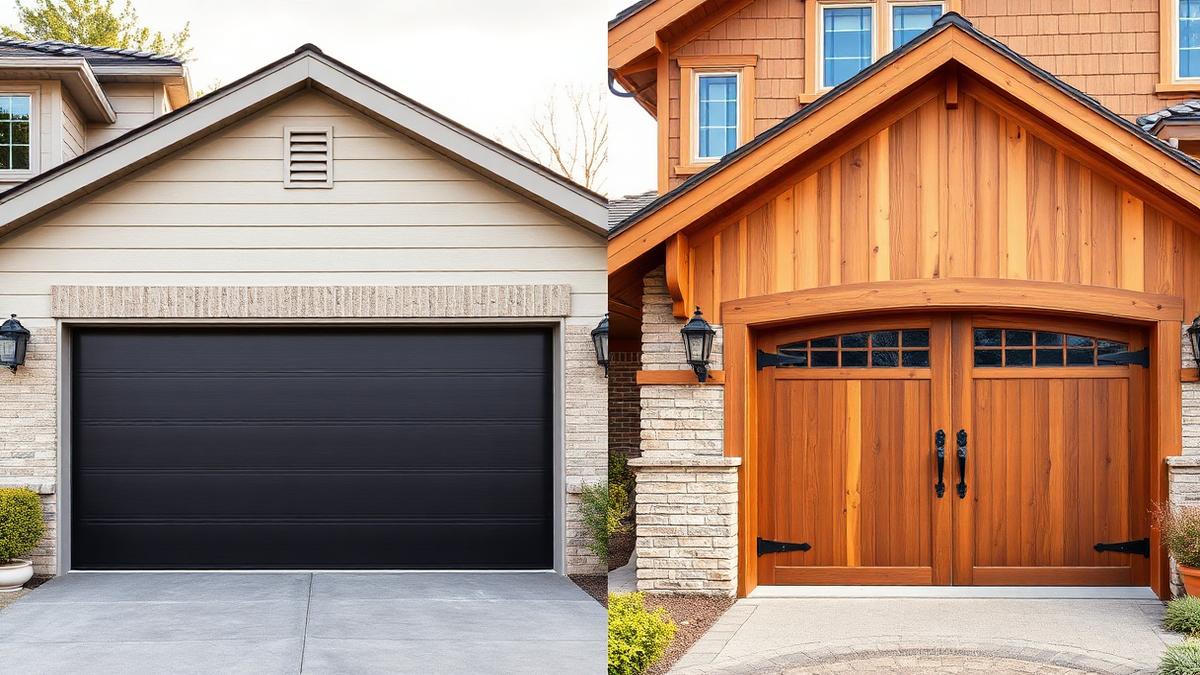
Choosing between a steel and a wood garage door isn't just a style question — it affects your energy bill, your maintenance schedule, and your resale value. Both are legitimate choices; they're just good at different things.
Here's an honest comparison to help you figure out which one fits your house and how you actually live.
Cost
Steel is the more affordable of the two, and by a wide margin. A quality insulated steel double-car door installed typically runs $1,400–$3,000 depending on style, insulation level, and window options. A basic non-insulated steel door can go under $1,000 installed, but we'd rarely recommend that for a heated or attached garage in the Carolinas.
Wood starts around $3,500 and easily climbs to $8,000–$12,000+ for custom carriage-style doors from a boutique manufacturer. You're paying for material, craftsmanship, and often a semi-custom build.
Maintenance
This is where steel really pulls ahead. A modern steel door with a baked-on finish needs almost nothing — a rinse with a garden hose twice a year and a hinge/spring lubrication annually. Ten years in, it should still look nearly new.
Wood is a different story. Even the best-sealed wood door in a humid climate like ours needs refinishing every 3–5 years to prevent cracking, warping, and moisture damage. If your door faces west or south with heavy sun exposure, plan on the shorter end of that range. Skip it and the door will show its age fast.
If you love the wood look but not the upkeep, faux-wood steel doors (steel with a woodgrain overlay or paint finish) have gotten genuinely good in the last decade. They fool most people from the curb.
Insulation and energy
Modern insulated steel doors come with polyurethane or polystyrene cores, typically rated R-9 to R-18. That matters a lot if your garage is attached, if there's a room above it, or if you use the space as a workshop or gym.
Solid wood has natural insulating properties but a lower R-value than a well-insulated steel sandwich door. Custom wood doors can be built with foam cores, but at that price point you're essentially back to weighing what you want to look at.
Curb appeal and resale
Wood wins on presence — there's no debate. On a Craftsman, farmhouse, or historic home, a real wood carriage door is often the single detail that pulls the whole facade together. For high-end homes in neighborhoods like Myers Park, Eastover, or the historic parts of Davidson and Rock Hill, a wood door can add real resale value.
On a mid-range home in a newer subdivision, though, a $10,000 wood door won't recoup its cost at sale. A quality faux-wood steel door will look almost as good from 30 feet away and cost a fraction.
Weight and hardware
Wood doors are heavy — often twice the weight of a comparable steel door. That means beefier springs, more expensive replacements down the road, and slightly more wear on your opener. It's not a dealbreaker, but it's worth knowing.
Quick recommendations
- Newer suburban home, want curb appeal without commitment: Insulated steel with a faux-wood finish.
- Attached garage used as living space, workshop, or gym: Insulated steel, R-15 or higher.
- Historic or high-end home where the door is a design feature: Real wood or a semi-custom composite.
- Rental or flip: Basic insulated steel. Best cost-to-durability ratio.
Both doors will last 20+ years if installed and maintained well. The right one is the one that matches how much time and money you actually want to put into it.
Need help with your garage door?
Call us at 704-614-4455 or request a free quote — same-day service across the Charlotte metro.